
Fasting Rules
 Meat
Abstain
 Fish
Abstain
 Dairy
Abstain
 Oil
Abstain
 Wine
Abstain
Saints & Commemorations
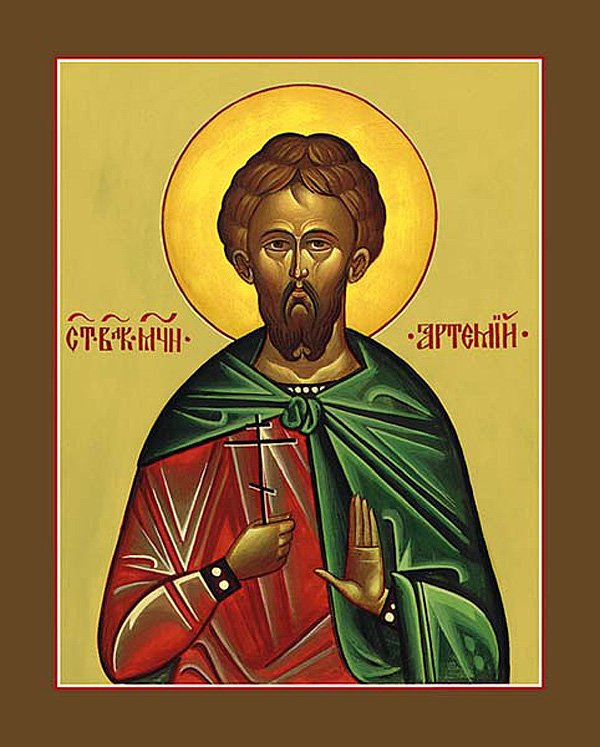
Great Martyr Artemius at Antioch
Holy Great Martyr Artemius of Antioch was a prominent military leader during the reigns of the emperor Constantine the Great (May 21), and his son and successor Constantius (337-361). Artemius received many awards for distinguished service and courage. He was appointed viceroy of Egypt. In this official position he did much for the spreading and strengthening Christianity in Egypt.
Holy Great Martyr Artemius of Antioch was a prominent military leader during the reigns of the emperor Constantine the Great (May 21), and his son and successor Constantius (337-361). Artemius received many awards for distinguished service and courage. He was appointed viceroy of Egypt. In this official position he did much for the spreading and strengthening Christianity in Egypt.
Saint Artemius was sent by the emperor Constantius to bring the relics of the holy Apostle Andrew from Patras, and the relics of the holy Apostle Luke from Thebes of Boeotia, to Constantinople. The holy relics were placed in the Church of the Holy Apostles beneath the table of oblation. The emperor rewarded him by making him ruler of Egypt.
The emperor Constantius was succeeded on the throne by Julian the Apostate (361-363). Julian in his desire to restore paganism was extremely antagonistic towards Christians, sending hundreds to their death. At Antioch he ordered the torture of two bishops unwilling to forsake the Christian Faith.
During this time, Saint Artemius arrived in Antioch and publicly denounced Julian for his impiety. The enraged Julian subjected the saint to terrible tortures and threw the Great Martyr Artemius into prison. While Artemius was praying, Christ, surrounded by angels, appeared to him and said, “Take courage, Artemius! I am with you and will preserve you from every hurt which is inflicted upon you, and I already have prepared your crown of glory. Since you have confessed Me before the people on earth, so shall I confess you before My Heavenly Father. Therefore, take courage and rejoice, you shall be with Me in My Kingdom.” Hearing this, Artemius rejoiced and offered up glory and thanksgiving to Him.
On the following day, Julian demanded that Saint Artemius honor the pagan gods. Meeting with steadfast refusal, the emperor resorted to further tortures. The saint endured all without a single moan. The saint told Julian that he would be justly recompensed for his persecution of Christians. Julian became furious and resorted to even more savage tortures, but they did not break the will of the saint. Finally the Great Martyr Artemius was beheaded.
His relics were buried by Christians. After the death of Saint Artemius, his prophecy about Julian the Apostate’s impending death came true.
Julian left Antioch for a war with the Persians. Near the Persian city of Ctesiphon, Julian came upon an elderly Persian, who agreed to betray his countrymen and guide Julian’s army. The old man deceived Julian and led his army into the Karmanite wilderness, where there was neither food nor water. Tired from hunger and thirst, Julian’s army battled against fresh Persian forces.
Divine retribution caught up with Julian the Apostate. During the battle he was mortally wounded by an unseen hand and an unseen weapon. Julian groaned deeply said, “You have conquered, Galilean!” After the death of the apostate emperor, the relics of the Great Martyr Artemius were transferred with honor from Antioch to Constantinople.
Saint Artemius is invoked by those suffering from hernias.
Troparion - Tone 4
Your holy martyr Artemios, O Lord, / through his sufferings has received an incorruptible crown from You, our God. / For having Your strength, he laid low his adversaries, / and shattered the powerless boldness of demons. / Through his intercessions, save our souls!
Kontakion - Tone 2
Let us gather to sing worthy hymns in honor of Artemios, / the pious and victorious martyr who defeated his enemies: / He is great among martyrs and generous in performing miracles, / and he intercedes with the Lord on behalf of us all!
Ven. Matrona of Chios
Saint Matrona was born in the village of Volissos on Chios of wealthy and pious parents, Leon and Anna sometime in the fourteenth century. From her youth she showed an inclination for monasticism. One day she left her parents and went to live in an unpopulated area, where she founded a small monastery for women.
Saint Matrona was born in the village of Volissos on Chios of wealthy and pious parents, Leon and Anna sometime in the fourteenth century. From her youth she showed an inclination for monasticism. One day she left her parents and went to live in an unpopulated area, where she founded a small monastery for women. Soon other nuns joined her in her ascetical struggles.
Saint Matrona worked many miracles both during her life and after her death, and was revered throughout Chios for her virtuous life and holiness. She showed charity to the poor, and was able to heal the sick.
The service to Saint Matrona was composed by Metropolitan Nikḗtas of Rhodes. It was found in a codex from 1455, which would indicate that she died sometime before this date.
Saint Matrona is also commemorated on July 15 (the finding of her head).
Troparion - Tone 3
Following in the footsteps of Christ, you forsook the pleasures of the world, O venerable one, / and in the flesh you imitated the life of the angels. / Therefore, you have filled Chios, your native isle, with joy, / and with the gifts bestowed by the Spirit, O all-praised maiden. / Therefore, we cry out to you with joy: “Rejoice, most blessed Matrona.”
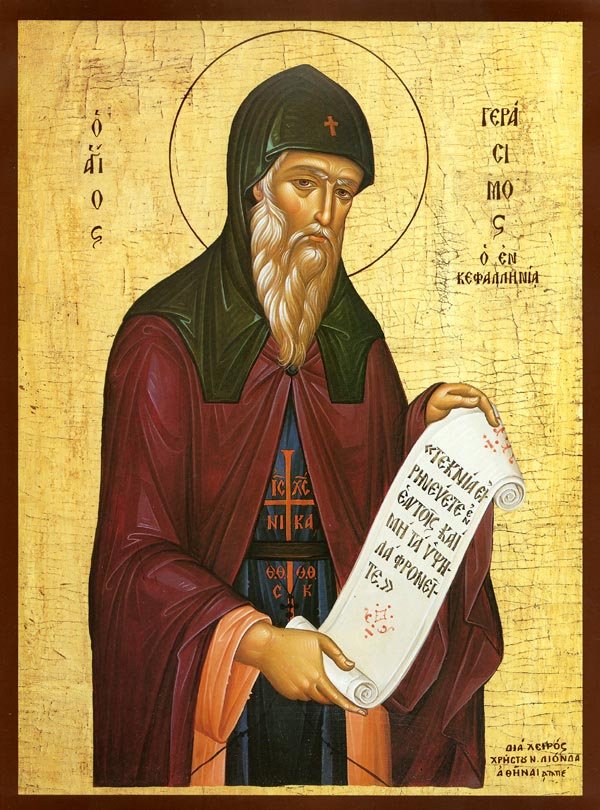
St Gerasimus the New, ascetic of Cephalonia (1579)
Saint Gerasimus the New Ascetic of Cephalonia was born in the village of Trikkala in the Peloponessos. As a young adult, he became a monk on the island of Zakynthos. On the Holy Mountain he became a schemamonk and studied with the ascetics of Mt Athos. Receiving a blessing from the Elders, the monk went to Jerusalem to worship at the Life-bearing Tomb of the Savior.
Saint Gerasimus the New Ascetic of Cephalonia was born in the village of Trikkala in the Peloponessos. As a young adult, he became a monk on the island of Zakynthos. On the Holy Mountain he became a schemamonk and studied with the ascetics of Mt Athos. Receiving a blessing from the Elders, the monk went to Jerusalem to worship at the Life-bearing Tomb of the Savior. After visiting many holy places in Jerusalem, Mount Sinai, Antioch, Damascus, Alexandria and Egypt, he returned to Jerusalem where he became a lamp-lighter at the Sepulchre of the Lord.
The monk was ordained a deacon and then a priest by the Patriarch of Jerusalem, Germanus (1534-1579). Saint Gerasimus maintained the discipline of an ascetic. For solitude he withdrew to the Jordan, where he spent forty days without respite. Having received the Patriarch’s blessing for a life of silence, Saint Gerasimus withdrew to Zakynthos in solitude, eating only vegetation.
After five years he was inspired to go the island of Cephalonia, where he lived in a cave. He restored a church at Omala, and he founded a women’s monastery where he lived in constant toil and vigil for thirty years. He prayed on bent knees stretched out on the ground. For his exalted life he was granted a miraculous gift: the ability to heal the sick and cast out unclean spirits.
At 71 years of age, the venerable Gerasimus knew that he would soon die. He gave his blessing to the nuns and peacefully fell asleep in the Lord on August 15, 1579. Two years later, his grave was opened and his holy relics were found fragrant and incorrupt with a healing power.
Since the Feast of the Dormition falls on August 15, Saint Gerasimus is commemorated on August 16th. Today’s Feast celebrates the uncovering of his holy relics in 1581.
Troparion - Tone 1
Let us the faithful praise the divine Gerasimos, / who is the protector of the Orthodox, and an angel in the body,
and a newly appeared God-bearing wonderworker; / for he has worthily received from God the unfailing grace of
healing; / he restores the sick, and heals those possessed by demons; / therefore, he pours forth healings upon those who honor him.
Kontakion - Tone 3
Today the island of Cephalonia / with sacred songs of thanksgiving, / calls upon all the Orthodox to extol the newly appeared boast and glory of Orthodoxy, / the divine Gerasimos, / who is truly her deliverer and champion.
St Jonah, Bishop of Manchuria (1925) (October 7 OC)
Note: St Jonah’s commemoration is October 7 on the Old Calendar, which falls on this day of the New Calendar.
He was orphaned in Russia at a young age, and, after attending the seminary in his home town of Kaluga, was tonsured as a monk at Optina Monastery. He was later ordained a priest, and taught in Kazan. I
Note: St Jonah’s commemoration is October 7 on the Old Calendar, which falls on this day of the New Calendar.
He was orphaned in Russia at a young age, and, after attending the seminary in his home town of Kaluga, was tonsured as a monk at Optina Monastery. He was later ordained a priest, and taught in Kazan. In his thirtieth year (1918) the Bolsheviks seized power and he was forced to flee. After many persecutions and sufferings, he joined a large party of Russians who fled across Turkestan and the Gobi Desert into China. There he was made Bishop, and immediately began working tirelessly to encourage his flock and to provide for their material needs (most had arrived in China with only the clothes on their backs). He established churches, opened soup kitchens and an orphanage, cared personally for the sick, and in every way personified a true Minister of Christ.
When his death approached (from an infection acquired while caring for the sick) he donned his epitrachelion, read the Canon for the Departure of the Soul, lay down on his bed and said ‘God’s will be done. Now I shall die.’ Within minutes he was dead. On the night of his funeral the Bishop appeared to a paralyzed ten-year-old boy, who was miraculously healed.
Scripture Readings
☩Epistle
Ephesians 5:25-33
25
Husbands, love your wives, even as Christ also loved the church, and gave himself for it;
26
That he might sanctify and cleanse it with the washing of water by the word,
27
That he might present it to himself a glorious church, not having spot, or wrinkle, or any such thing; but that it should be holy and without blemish.
28
So ought men to love their wives as their own bodies. He that loveth his wife loveth himself.
29
For no man ever yet hated his own flesh; but nourisheth and cherisheth it, even as the Lord the church:
30
For we are members of his body, of his flesh, and of his bones.
31
For this cause shall a man leave his father and mother, and shall be joined unto his wife, and they two shall be one flesh.
32
This is a great mystery: but I speak concerning Christ and the church.
33
Nevertheless let every one of you in particular so love his wife even as himself; and the wife see that she reverence her husband.
☩Gospel
Luke 9:44-50
44
Let these sayings sink down into your ears: for the Son of man shall be delivered into the hands of men.
45
But they understood not this saying, and it was hid from them, that they perceived it not: and they feared to ask him of that saying.
46
Then there arose a reasoning among them, which of them should be greatest.
47
And Jesus, perceiving the thought of their heart, took a child, and set him by him,
48
And said unto them, Whosoever shall receive this child in my name receiveth me: and whosoever shall receive me receiveth him that sent me: for he that is least among you all, the same shall be great.
49
And John answered and said, Master, we saw one casting out devils in thy name; and we forbad him, because he followeth not with us.
50
And Jesus said unto him, Forbid him not: for he that is not against us is for us.
Liturgical data sourced from OCA.org and orthocal.info