
Fasting Rules
 Meat
Allowed
 Fish
Allowed
 Dairy
Allowed
 Oil
Allowed
 Wine
Allowed
Saints & Commemorations
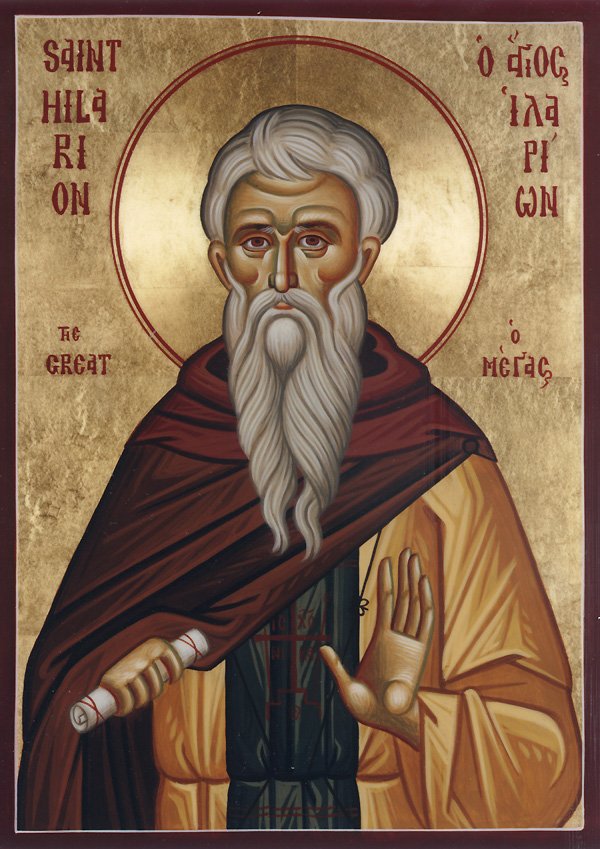
Ven. Hilarion the Great
Saint Hilarion the Great was born to pagan parents in the year 291 in the Palestinian village of Thabatha near Gaza. As a young man, he was sent to Alexandria for his education. There he became acquainted with Christianity and was baptized. After hearing an account of the angelic life of Saint Anthony the Great (January 17), Hilarion went to meet him, desiring to study with him and learn what is pleasing to God.
Saint Hilarion the Great was born to pagan parents in the year 291 in the Palestinian village of Thabatha near Gaza. As a young man, he was sent to Alexandria for his education. There he became acquainted with Christianity and was baptized. After hearing an account of the angelic life of Saint Anthony the Great (January 17), Hilarion went to meet him, desiring to study with him and learn what is pleasing to God. Hilarion soon returned to his native land to find that his parents had died. After distributing his family’s inheritance to the poor, Saint Hilarion went forth into the desert surrounding the city of Maium.
In the desert the Saint endured violent struggles with impure thoughts, vexations of the mind, and the burning passions of the flesh, but he defeated them through heavy labor, fasting and fervent prayer. The devil sought to frighten him with phantoms and apparitions. While he was praying Saint Hilarion would sometimes hear children crying, women wailing, and the roaring of lions and other wild beasts. He understood that the demons were causing these terrors in order to drive him out of the wilderness. He overcame his fear by resorting to fervent prayer. Once, some thieves fell upon Saint Hilarion, and he persuaded them to forsake their lawless life by the power of his words.
Soon all of Palestine heard about Saint Hilarion and of the miracles he worked. The Lord granted the holy ascetic the power to cast out unclean spirits. With this gift of grace he loosed the bonds of many of those who were afflicted. The sick came for healing, and the Saint cured them without asking for any payment, saying that the grace of God is freely received, and must be freely given (Matthew 10:8).
Such was the grace that he received from God that he could tell by the smell of someone’s body or clothing which passion was afflicting his soul. They came to Saint Hilarion desiring to save their souls under his guidance. With his blessing, monasteries began to spring up throughout Palestine. Going from one monastery to another, he instituted a strict ascetic manner of life.
About seven years before his death (+ 371-372) Saint Hilarion moved back to Cyprus, where the ascetic lived in a solitary place until the Lord summoned him to Himself.
Saint Hilarion is sometimes depicted holding a scroll which reads: "The tools of a monk are steadfastness, humility, and love according to God." In iconography, is depicted as an old man with a brown, rush-like beard divided into three points.
Troparion - Tone 8
By a flood of tears you made the desert fertile, / and your longing for God brought forth fruits in abundance. / By the radiance of miracles you illumined the whole universe! / Our Father Hilarion pray to Christ God to save our souls!
Kontakion - Tone 3
Today we gather to praise you with hymns, / O unfading light of the Spiritual Sun; / for you illumined those in the darkness of ignorance, / leading all to the heights of God, as they cried: / “Rejoice, Father Hilarion, rampart of ascetics.”
Righteous Philotheus
Saint Philotheos of Dionysiou Monastery on Mount Athos was a native of Elateia, and was born in 1526. Fearing the Turks, his parents moved away to Chrysoupolis in Macedonia, where his father soon died. The child Philotheos and his brother were seized by the Turks and then thrown into prison.
They were delivered in a miraculous manner by the Mother of God.
Saint Philotheos of Dionysiou Monastery on Mount Athos was a native of Elateia, and was born in 1526. Fearing the Turks, his parents moved away to Chrysoupolis in Macedonia, where his father soon died. The child Philotheos and his brother were seized by the Turks and then thrown into prison.
They were delivered in a miraculous manner by the Mother of God. She appeared to the children in the likeness of their mother and led them to the monastery of the Most Holy Theotokos in the city of Neapolis in Asia Minor. At this monastery the brothers received the monastic tonsure. By progressing through all the obediences assigned by the Igoumen they attained the position of ecclesiarchs.
Meanwhile, Eudokia, the mother of Saint Philotheos, had also settled into a women’s monastery in this same city, through the mysterious guidance of Divine Providence. For many years she knew absolutely nothing of the fate of her children. Visiting a men’s monastery with several other nuns for the Feast Day of its church, Eudokia recognized her sons. In answer to her question about how they chanced to be there they replied, “You ought to know, for you yourself freed us from the Turks and led us from the prison.” Thus Eudokia became convinced of the intercession of the Mother of God, for it had only been in praying to the Theotokos that she had found any consolation. When the brethren learned of the joyous reunion of the mother and her sons, as well as their miraculous deliverance, they gathered around them and glorified the Lord.
In 1551, after his mother’s repose, Saint Philotheos went to the Holy Mountain at the age of 25. He joined the brethren of Dionysiou Monastery, where his ascetic struggles were an example to many. Later, seeking greater quietude, he pretended to have suffered from an illness and become deaf, and then he retired to a cave outside the monastery. There he emerged as an admirable ascetic and a conqueror of demons. When his feigned illness was revealed, he was forced to change his place of residence, so that people would not honor him. In his new home he acquired three disciples. Devoting himself to deeds of prayer, Saint Philotheos attained high spiritual perfection and was granted the gift of clairvoyance.
In 1610 the venerable one peacefully fell asleep in the Lord at the age of eighty-four. Before his death he bade his disciples not to bury his body, but rather to cast it dishonorably into the forest to be eaten by beasts and birds. His disciples fulfilled the wish of their Elder, but the All-Good God glorified the saint’s relics with a wondrous radiance. A monk took his skull and gave it to the saint’s disciples.
The life of the venerable one was written by the monk Daniel of Dionysiou, copying an older codex, which was compiled by the monk Agapios Lantos in 1802, which was later published in Venice in 1872.
Troparion - Tone 3
As one rescued from the hands of ungodly by the grace of the Theotokos, / you lived righteously in the Monastery at Neapolis, / and then you struggled on Athos, / where you were called the friend of God. O Venerable Father Philotheos, / intercede with Christ God, that He may grant us great mercy.
Kontakion - Tone 8
You became a stranger to worldly friendships, / becoming an abode of divine inspiration, / and God has magnified you, O God-bearer. / But as a genuine friend of the Savior, / deliver from lesser friendships those who cry to you; / “Rejoice, O Father Philotheos.”
Holy New Martyr John of Monembasia (1773)
Saint John was born in 1758 near the city of Monemvasia. His father was a priest from Geraki, and his mother was from the neighboring village of Gouves. It was in Gouves that John's father was assigned as a priest, and there John was born. From a young age John tried to emulate his father by helping him work in the church.
Saint John was born in 1758 near the city of Monemvasia. His father was a priest from Geraki, and his mother was from the neighboring village of Gouves. It was in Gouves that John's father was assigned as a priest, and there John was born. From a young age John tried to emulate his father by helping him work in the church. He was known for his exemplary behavior, and referred to by other children as the "priest's son."
In the year 1770 the army of the Albanian Hatzi Osman defeated the Greek resistance, and arriving in Monemvasia they killed John's father and enslaved both him and his mother. They were taken to Larisa, where they were sold separately two or three times.
After two years they were bought by the same man, a Turkish landowner. This Turk had no children, and recognizing John's good qualities (he was exceptionally intelligent for his age, obedient, and a hard worker), the man wanted to adopt John after converting him to Islam. Every day they tried to persuade him to abandon the Christian Faith and become a Turk. Initially, they used flattery and promises, but later they used terrible tortures to overcome John's steadfastness (he was only 15 years old), but he remained unwavering in his Christian faith.
One day his master, tired of trying to convince him to convert, and in anger led him to the courtyard of the mosque. Many Muslims were gathered there, and with blows and terrible threats they urged him to convert and become a Turk. John's response was clear: "I am not a Turk, I am a Christian and I shall die as a Christian."
In addition, the Turk and his wife tried every day with magic and evil spells to make the Saint lose his mind and give in to carnal desires, and then to become a Turk. But John remained pure, for the grace of Christ protected him from all of the diabolical devices of the Turk's wife.
Soon came the fifteen days of fasting before the Dormition of the Theotokos. The Turk realized that John did not wish to break the fast, so he locked him up in a barn. He kept him there for the entire fifteen days and hung him up, lighting a fire in the straw beneath him to cause smoke, and struck him with the flat of his sword, all the while trying to make him eat their abominable foods and break the fast. But Saint John did not even taste the food, but prayed to the Mother of God, in whose honor the Fast is observed, asking her to help him keep the fast, for he preferred to die rather than break his fast.
The master, seeing that he remained unconvinced, left him without food for two and three days at a time. His mother, seeing him weakened by the tortures and the fasting, tried to convince him to give in, saying: "Eat these foods, my son, so that you do not perish. God and the Panagia will forgive you, because you would not be doing this voluntarily, but out of necessity. Pity me, your poor mother. Do not die and leave me alone in this foreign land, for by having you here, I feel as if I am not a slave."
John replied: "Why are you doing this, Mother, and why are you crying? Why don't you emulate the Patriarch Abraham, who for the love of God wanted to sacrifice his only son, yet you only cry and weep. I am a priest's son and I should be keeping the laws and customs of our Church more than the sons of laymen, for if we don't keep the small things [of the faith], how can we keep the larger things?"
Soon after this response the furious Turk stabbed him in the heart on October 19, 1773. After two days Saint John died and received the crown of martyrdom.
Saint John's skull and portions of his hand and feet are located at the Zermbitsa Monastery in Sparta, and other portions of his relics are in the churches of the Forty Martyrs of Sebaste in Larisa and Voulkanou Monastery in Messenia.
Troparion - Tone 3
O John, divine offspring of Monemvasia, / you budded forth and bore fruit; / by the grace of faith you kept the commandments of the Fathers, / and put the Hagarenes to shame by your struggle. / O glorious Martyr, entreat Christ God to grant us great mercy.
Scripture Readings
☩Epistle
Ephesians 5:33-6:9
33
Nevertheless let every one of you in particular so love his wife even as himself; and the wife see that she reverence her husband.
1
Children, obey your parents in the Lord: for this is right.
2
Honour thy father and mother; (which is the first commandment with promise;)
3
That it may be well with thee, and thou mayest live long on the earth.
4
And, ye fathers, provoke not your children to wrath: but bring them up in the nurture and admonition of the Lord.
5
Servants, be obedient to them that are your masters according to the flesh, with fear and trembling, in singleness of your heart, as unto Christ;
6
Not with eyeservice, as menpleasers; but as the servants of Christ, doing the will of God from the heart;
7
With good will doing service, as to the Lord, and not to men:
8
Knowing that whatsoever good thing any man doeth, the same shall he receive of the Lord, whether he be bond or free.
9
And, ye masters, do the same things unto them, forbearing threatening: knowing that your Master also is in heaven; neither is there respect of persons with him.
☩Gospel
Luke 9:49-56
49
And John answered and said, Master, we saw one casting out devils in thy name; and we forbad him, because he followeth not with us.
50
And Jesus said unto him, Forbid him not: for he that is not against us is for us.
51
And it came to pass, when the time was come that he should be received up, he stedfastly set his face to go to Jerusalem,
52
And sent messengers before his face: and they went, and entered into a village of the Samaritans, to make ready for him.
53
And they did not receive him, because his face was as though he would go to Jerusalem.
54
And when his disciples James and John saw this, they said, Lord, wilt thou that we command fire to come down from heaven, and consume them, even as Elias did?
55
But he turned, and rebuked them, and said, Ye know not what manner of spirit ye are of.
56
For the Son of man is not come to destroy men’s lives, but to save them. And they went to another village.
Liturgical data sourced from OCA.org and orthocal.info